Breathing Technique No. 1 – The Physiological Sigh
In 2023, Stanford neuroscientist Dr. Andrew Huberman and his colleagues published research identifying what they called the single fastest tool for real-time stress reduction. It's not a meditation app. It's not a supplement. It's a specific breathing pattern your body already knows.
"One double inhale followed by a long, complete exhale. Ninety seconds. Done. Your nervous system physically shifts."
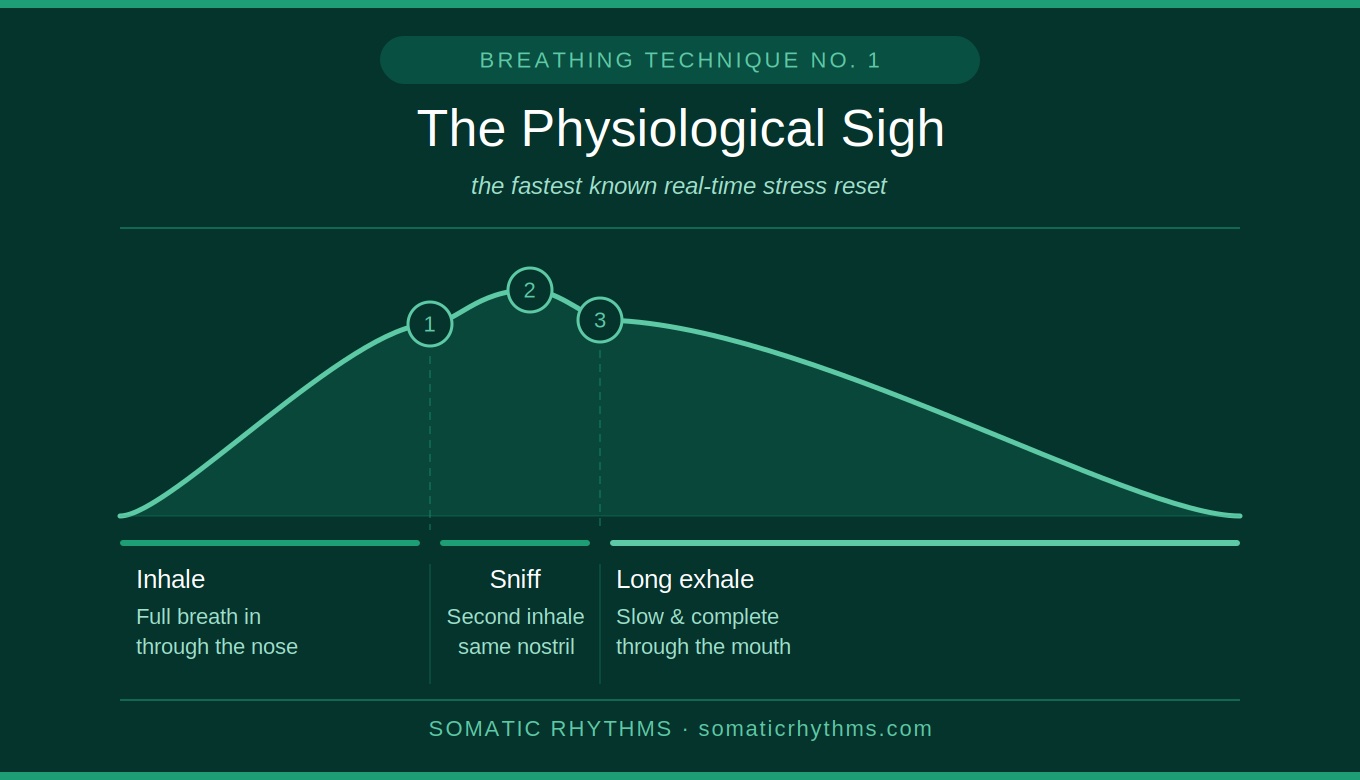
The Pattern
Inhale 1
A full breath in through the nose
Inhale 2
A sharp secondary sniff through the nose at the top (pops collapsed air sacs)
Exhale
A long, slow, complete breath out through the mouth
Repeat
1–3 cycles — more is rarely needed
What the Science Says
When you're under sustained stress, tiny air sacs in your lungs called alveoli begin to collapse. This reduces gas exchange efficiency and elevates CO2 — which your body reads as a threat signal, accelerating the stress response. The double inhale physically re-inflates these sacs, restoring full respiratory capacity.
The extended exhale is equally critical. Your exhale activates the parasympathetic branch of the autonomic nervous system directly — it slows the heart and signals safety to the brain. The longer the exhale relative to the inhale, the stronger the effect. The physiological sigh maximizes this ratio in a single breath.
The Stanford trial found this technique outperformed mindfulness meditation, box breathing, and cyclic hyperventilation in reducing self-reported anxiety, improving mood, and lowering physiological stress markers — across a five-minute trial period. One technique. Real-time results.
A Note from Mark
I now teach this in every session as a take-home tool, something you can use immediately before a difficult conversation or in the middle of a negotiation. What I find interesting is that clients often notice, once they start doing this consciously, that their body was already doing it spontaneously at moments of high stress. We sigh naturally as a self-regulation mechanism and to reduce CO2 buildup. This is just doing it on purpose.